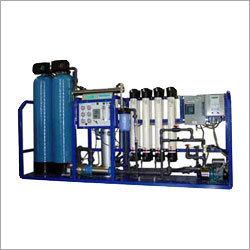
Reverse Osmosis Systems for Process & Drinking
Reverse osmosis is the process of forcing a solvent from a region of high solute concentration through a membrane to a region of low solute concentration by applying a pressure in excess of the osmotic pressure. This is the reverse of the normal osmosis process, which is the natural movement of solvent from an area of low solute concentration when no external pressure is applied. The membrane here is semipermeable that allows the passage of solvent but not of solute.
Our Eco water's reverse osmosis systems possess highest quality components. These systems are designed to emphasize most on functioning, affordability, easy operation and system expandability.
Our Reverse osmosis treatment plants produce high quality permeate water from seawater, municipal and well water. The production rate is based on feed water at 25°C, with turbidity of less than 1 NTU, silt density index (SDI) of less than 5. The sea water RO systems are designed for a total dissolved solids of 36,000.
The reverse osmosis process uses semi permeable spiral wound membranes to separate and remove dissolved solids, organic, pyrogens, sub micron colloidal matter and bacteria from water. Feed water is delivered under a pressure of approximately 16 kg/cm2 through reverse osmosis membranes. Water permeates the minute pores of the membrane and is delivered as purified water. Impurities in the water are concentrated in the reject stream and flushed to drain. Reverse osmosis is capable of removing 90-99% of total dissolved solids (TDS), 99% of organic, including pyrogens, and 99% of all bacteria in the feed water.
The impurities are concentrated as the feed water passes through the reverse osmosis system and flows over the membrane. Impurities removed from the feed water are concentrated in the concentrate, or the reject stream. As impurities concentrate, they may reach saturation and precipitate. The operator must be certain that impurities in the feed water are not concentrated enough in the RO membranes to cause precipitation because precipitation can ruin the membranes.
Reliable High Purity Water for Process and Drinking ApplicationsDesigned for industrial, commercial, and institutional use, this RO system employs high-efficiency TFC membranes to deliver exceptional TDS rejection and purity. Its flexible capacity and robust chassis construction make it suitable for demanding environments where quality and safety matter.
Advanced Control and Monitoring FeaturesWith a digital or PLC-based control panel, this system allows for real-time online monitoring of conductivity and flow, providing detailed water quality insights. Safety features like high and low pressure protection help ensure uninterrupted operation and long service life.
Customizable Options for Diverse Water SourcesVersatile by design, this RO system can process various water types, including borewell, municipal, and even brackish water. Available storage tanks, customized connection sizes, and a range of skid materials ensure seamless integration into your facility.
FAQs of Reverse Osmosis Systems for Process & Drinking:
Q: How does a Thin Film Composite (TFC) membrane benefit the RO systems performance?
A: TFC membranes provide superior TDS rejection rates, up to 99.5%. Their advanced construction allows for higher water permeability while maintaining excellent contaminant removal, enhancing both the efficiency and longevity of the RO system.
Q: What pretreatment is required before using the RO system?
A: It is recommended to use sand and carbon filters as pretreatment. These filters help remove larger particulates and organic compounds, thereby protecting the RO membrane from fouling and ensuring optimal system operation.
Q: When should I use a process and drinking RO system like this one?
A: This system is ideal whenever you need consistently high-quality water for applications such as process water treatment, pharmaceuticals, food & beverage, hospitals, and general industrial usesespecially where water purity and reliability are critical.
Q: Where can the Reverse Osmosis system be installed?
A: The system is suitable for installation in a variety of settings, including industrial plants, hospitals, food processing units, and institutional campuses. Mounting options include both skid-mounted and floor-mounted designs for easy integration.
Q: What is the process for water purification in this RO system?
A: Feed water passes through recommended sand and carbon pretreatment, then enters the RO unit where high-pressure pumps drive water through the TFC membrane. Dissolved solids and contaminants are removed, delivering high-purity product water to the storage tank.
Q: What are the key benefits of using this RO system?
A: The main benefits include extremely high purity levels (up to 99%), reliable operation with built-in safety features, real-time monitoring for quality assurance, customizable volumes, and compatibility with various water sources.
Q: How is maintenance managed with the advanced control system?
A: The digital or PLC-based control panel provides real-time data on water quality and system parameters. This allows for timely maintenance and troubleshooting, extending system life and minimizing downtime.